
Cobrowse has introduced a new AI-powered visual intelligence product designed to give virtual agents full real-time awareness of the customer’s digital experience – a capability long considered the missing piece in CX automation.
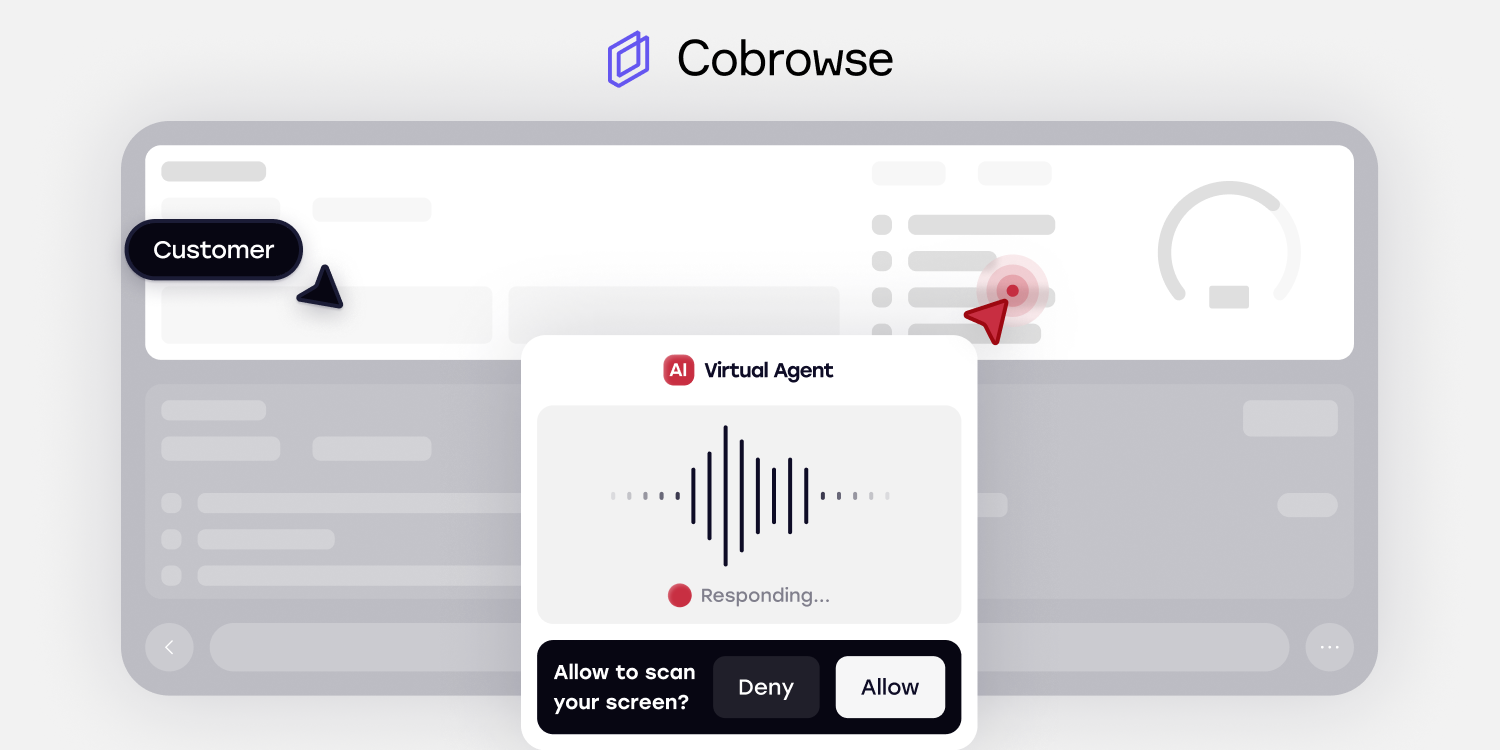
The new release allows AI agents to view the customer’s screen, interpret on-page elements, spot friction points, guide users with on-screen annotations, and hand off to human agents with complete contextual history.
It combines these capabilities with enterprise-grade redaction, auditing, and privacy controls, positioning the solution as a major leap in safe, context-driven AI support.
Indeed, Corbrowse believes that only after outlining these capabilities does the core problem become clear.
As Zac Scalzi, Director of Sales at Cobrowse, told CX Today:
“AI agents transformed how customers communicate, but they still lack the context required to actually solve problems. Until AI can see what the user sees, every answer is an educated guess.”
The “Context Gap” Holding AI Back
Large language models allow virtual agents to understand intent and deliver increasingly natural conversations.
But as Scalzi notes, “they still don’t see the actual user interface, what the user is doing, what errors are shown, or the UI obstacles encountered.”
This lack of grounding is what Cobrowse calls the “context gap”: the fundamental reason AI often sounds helpful yet fails to deliver meaningful resolution.
Customers end up repeating themselves, agents resort to guesswork, and support escalations pile up.
Cobrowse’s official product page argues that “LLMs can interpret and relay information, but without visual context they cannot reason. They behave like a searchable knowledge base, not an intelligent support agent.”
The vendor is emphatic that solving this gap is essential for businesses to thrive in the next era of agentic AI.
What Cobrowse AI Actually Brings to Virtual Agents
The new Cobrowse AI platform introduces capabilities traditionally reserved for human-assisted cobrowsing, but now fully integrated with automated support flows. These include:
Real-Time Visibility into UI State
Virtual agents can observe the customer’s web or mobile session, enabling them to identify errors, locate confusing elements, and understand exactly where a user is stuck.
Situation-Aware Guidance
Cobrowse notes that AI can now “visually direct customers with drawing and annotation tools,” giving step-by-step guidance instead of generic instructions.
Intelligent Analysis of Friction
The product interprets UI behavior and friction points in real time, giving AI agents the context needed to provide precise and timely instructions.
Seamless Escalation
If a case requires human intervention, the AI hands over with full visual and conversational history – eliminating the need for the customer to restate the issue.
Enterprise-Grade Safeguards
The platform includes redaction controls, audit logging, and deployment options tailored for regulated industries.
Scalzi described the solution’s ambition clearly, stating:
“Cobrowse AI elevates existing AI strategies by giving agents the context they need to reason. It shifts AI from relaying information to resolving issues autonomously.”
Why This Release Matters for the Broader CX Landscape
Even as enterprises invest heavily in AI assistants and copilots, many remain disappointed by low containment and inconsistent accuracy.
According to Scalzi, that frustration stems from over-reliance on data inputs that lack situational understanding.
“Most companies try to feed AI more information, such as FAQs, documentation, and logs, but without visual grounding, the AI is still guessing,” he said.
Teams often attempt to patch the issue by building custom APIs that expose product state to the AI. Yet, according to Cobrowse, these approaches are “engineering-intensive, fragile, and often introduce privacy risks.”
Cobrowse AI aims to eliminate these workarounds, giving virtual agents the context they need without custom engineering or risky integrations.
Expected Outcomes for Support Organizations
Like any AI solution, it all boils down to whether or not the tool can really deliver measurable results.
Cobrowse highlighted the following areas where it believes adopters can expect meaningful gains:
- Higher containment: More issues resolved entirely by AI.
- Greater accuracy and understanding: Virtual agents can interpret intent with UI awareness rather than assumptions.
- Improved CSAT: Customers experience interactions that feel relevant and confident.
- Higher FCR: AI agents can complete end-to-end resolutions rather than pushing users through multiple steps.
- Better digital adoption: Users learn the product as they’re guided through real workflows.
The company’s website claims that Cobrowse AI “gives your virtual agents the context they need to guide, resolve, and drive digital confidence.”
A Step Toward AI That Truly Understands Customers
Cobrowse’s latest release delivers something that conversational systems have historically lacked: the shared visual context that makes human-to-human support efficient and intuitive.
The company argues that this advancement is essential for agentic AI, as it enables the technology to not only speak like a human, but also think and respond like one.
In discussing the broader context of AI evolution, Scalzi summed up this point nicely:
“Without context, AI is little more than a smart FAQ. With visual intelligence, it can finally operate with real understanding.”
For organizations seeking to scale automation without sacrificing quality, this release may signal a new path forward.